
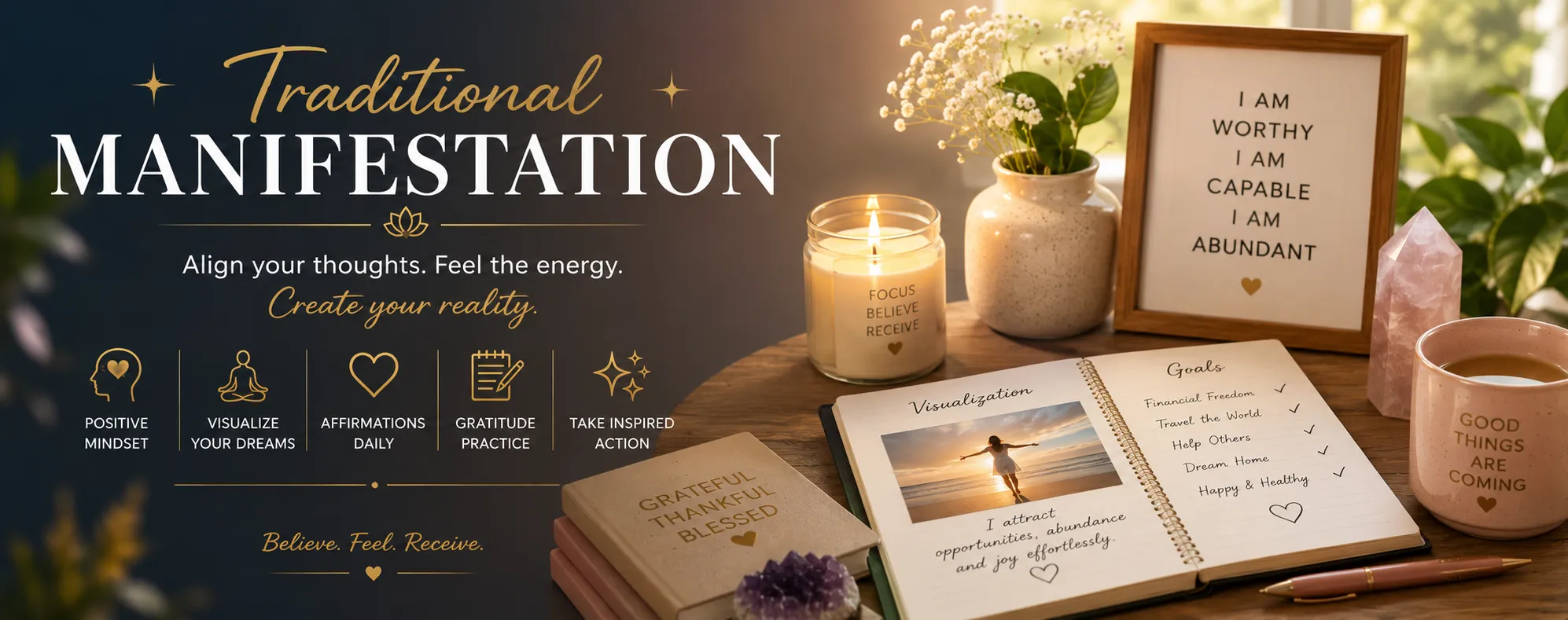
Traditional manifestation is a broad term used to describe practices through which people focus their thoughts, beliefs, intentions, and actions on the life they hope to create. Long before modern manifestation became popular through social media, books, and personal-development programs, cultures around the world used forms of prayer, visualization, ritual, affirmation, gratitude, and intentional living to give meaning and direction to their aspirations.
Although traditional manifestation is sometimes described as a way to attract specific events simply by thinking about them, a more grounded interpretation views it as a practice for clarifying desires, strengthening commitment, and encouraging purposeful action.
The Roots of Manifestation
The idea that thoughts and intentions can influence how we experience life has appeared in many philosophical, spiritual, and cultural traditions. People have used prayer, meditation, contemplation, ceremonies, affirmations, and symbolic practices to express hopes and aspirations for generations.
These traditions differ significantly from one another. Some are religious, some spiritual, and others are primarily focused on personal development. Therefore, there is no single traditional manifestation system that applies universally.
What many practices share is the idea of intentionally directing attention toward something meaningful.
The Power of Intention
Intention is one of the central ideas behind traditional manifestation. An intention provides a clear direction for your thoughts and actions.
For example, someone who wants to build a more fulfilling career might establish an intention to develop new skills, build professional relationships, and pursue opportunities aligned with their values.
Writing this intention down can make it more tangible. Repeating it regularly can also serve as a reminder of the direction the person wants to take.
The value of intention does not come from guaranteeing a particular outcome. Instead, it can help people remain focused on what matters to them.
Visualization and Mental Rehearsal
Visualization is another widely used manifestation practice. It involves creating a detailed mental picture of a desired experience or goal.
Traditional visualization often emphasizes imagining the outcome—a successful career, a healthy relationship, a peaceful home, or a personal achievement.
A practical approach can go one step further by visualizing the process as well. Imagine making the necessary decisions, overcoming obstacles, learning new skills, and taking consistent action.
This approach keeps manifestation connected to realistic behavior rather than treating visualization as a guarantee of results.
Affirmations and Positive Thinking
Affirmations are short statements designed to reinforce particular beliefs, values, or intentions.
Examples include:
“I am capable of learning and growing.”
“I am committed to taking meaningful action.”
“I choose to focus on opportunities within my control.”
Traditional manifestation often encourages people to repeat affirmations regularly. However, affirmations tend to be more useful when they feel personally meaningful and are supported by behavior.
Simply repeating a statement does not guarantee that circumstances will change. The real value may come from using the statement as a reminder of the attitudes and actions you want to cultivate.
Gratitude as a Manifestation Practice
Gratitude is another common element of traditional manifestation.
A gratitude practice encourages people to recognize positive aspects of their current circumstances rather than focusing exclusively on what they lack. This can be as simple as writing down three things you appreciate each morning or evening.
Gratitude does not mean ignoring difficulties. Instead, it can provide a more balanced perspective while helping people notice relationships, opportunities, experiences, and resources they may otherwise overlook.
Vision Boards and Symbolic Reminders
Vision boards became popular as a visual form of manifestation. They typically combine photographs, words, quotes, and symbols representing a person’s goals.
The purpose is to create a visual reminder of what the individual wants to work toward.
A well-designed vision board can include career aspirations, personal-development goals, travel experiences, relationships, health objectives, creative projects, and other meaningful ambitions.
The board itself does not guarantee that these things will happen. Its practical value is as a visual cue that keeps important priorities visible.
Manifestation and Action
One of the most important principles of a grounded manifestation practice is the connection between intention and action.
Wanting a new career may encourage someone to update their résumé, acquire new skills, contact potential employers, or explore new industries.
Wanting better relationships may encourage someone to communicate more openly, establish healthier boundaries, and invest time in meaningful connections.
In this sense, manifestation becomes less about waiting for circumstances to change and more about becoming intentional about the choices that are within your control.
Creating a Traditional Manifestation Routine
A simple routine can combine several traditional practices.
Begin with a few minutes of quiet reflection. Identify one important intention for the day. Visualize yourself making progress toward it. Write a short affirmation that reinforces the mindset you want to cultivate. Then identify one practical action you can take.
At the end of the day, reflect on what happened. Consider what worked, what you learned, and what you can improve tomorrow.
Consistency matters more than complexity.
A Balanced Perspective
Traditional manifestation can be a meaningful personal-development practice when approached thoughtfully. It can provide structure for reflection, clarify goals, encourage optimism, and remind people to act intentionally.
However, manifestation should not be treated as a substitute for planning, education, professional advice, medical care, or financial decision-making. Life is influenced by circumstances, other people, opportunities, and factors beyond individual control.
The most constructive approach is to combine intention with realistic expectations and consistent action.
Ultimately, traditional manifestation is not simply about wishing for a different future.